2026
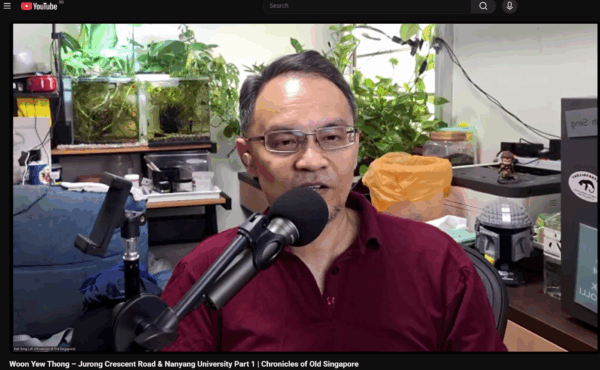
Overview
Click on the above link to view the Youtube Podcast.
Transcript of Podcast Interview provided by Dr. Loh Kah Seng:
Introduction
Welcome to Chronicles of Old Singapore.
This is Dr. Lok, the people’s historian, and I document people’s memories of Singapore before it became a global city.
Do like the video and subscribe for future episodes.
This will help us a lot.
Very happy this morning to have a guest with us.
We are going to look at a part of Singapore that I know very little about and which is also quite close to the historic
Nanyang University, you know. So we can talk about that part of Jurong as well as a bit of Nanyang University as well.
That part of Jurong is the Jurong Crescent Road.
Talk about that because he lived there with his family in the 1960s is Mr. Woon Yew Thong.
Mr. Woon, how are you?
Very good. Thank you very much. Dr. Loh, very happy that you are here to share with us.
We got connected I think about a month ago when I saw your very nice kind of a slideshow video on YouTube containing all the marvelous
photographs that your family had of your time there at Jurong Crescent Road. Right. Yep.
Tell us a little bit about yourself.
Well, I’m actually retired now. I used to work in a multinational company in the flavor and fragrance business.
So could you tell us which MNC that was?
International Flavors & Fragrances.
What do they do?
Well, if you look at all the drinks that you buy from F&N or Starbucks, they likely have flavors in their drinks from companies like ours. If you buy instant noodles, most likely the seasoning contains flavors that we developed. As for fragrances, we create and develop them for major global fragrance brands.
How long were you with them?
More than 22 years.
And what did you do?
I was a business analyst. We tried to understand what customers wanted, what they bought, who our competitors were, what they sold, and what our market share was, you know. [laughter]
Right? All the crucial stuff, right?
Yeah.
Chapter 2: My Search for the Past
So, after 22 years at this MNC as a business analyst, where did the heritage and memory aspect come in? Was it always there, or did it come to you more recently?
Well, I’ve been documenting my history, especially my family history. When my father died about 10 years ago, I realized I knew very little about his past because he had suffered a stroke, and I was unable to communicate with him properly when I was growing from a teenager into an adult. So I lost many opportunities to learn about his past life.
That triggered a motivation in me to document my own past as well as my parents’ past for future generations, so they would know where we came from and how we grew up in Singapore.
Tragedy kind of had a silver lining, right? Often it is something like that which makes us realize how important certain things are, things we may have neglected previously. So am I right to say that your dad never talked very much about his early days?
He was a very strict person. He grew up during the Second World War and, as you know, Singapore was occupied by the Japanese. So he had a very hard time where food was scarce and freedom was not easily available.
So he became a very thrifty man, and he believed strongly in discipline. That’s where he instilled his philosophy in me.
What is his name?
My father’s name is Woon Kai Boon.
And your mother too, is she also part of this story?
Oh yes, definitely. Unfortunately, when I was about 12 years old, my mom died. So I lost her and all her memories. I never had the chance to speak to her as an adult. At 12 years old, I don’t think I was mature enough to have adult discussions with her about her past.
For example, how did she meet my father? What was interesting was that I later went to her relatives, her brothers and sisters, and talked to them to find out what her life was like before. I heard many very interesting stories.
I mean, that’s so tragic again, right? Like you didn’t know your mother for most of your life. What was her name?
Chan Yee Keng.
Yeah. The next question I was going to ask was exactly what you mentioned — how did you go about piecing together all the fragments and memories of your parents’ lives? Was it a challenge?
It was a challenge because, as you know, the older generation didn’t tend to talk much. But over the last 10 years working on this project, I gathered information from many relatives I met.
I discovered many interesting things. For example, my father’s name is Woon Khai Boon, and I had always presumed he belonged to the Woon family for many centuries. But during my research, I found out that during the Second World War he was actually adopted.
That means he was not the biological son of my grandfather.
So that became a very interesting point. How would I then find the roots of my father? Where did he actually come from? It was very challenging, and unfortunately, I couldn’t find additional information. But I did discover much more about my grandfather.
Do you know the circumstances under which your father was adopted?
Yes. It’s quite embarrassing actually. [laughter] Maybe I should not reveal too much here, but I can give you a hint.
At that time, my grandfather was a businessman. He had a daughter, but he wanted a son, so he decided to adopt one in order to continue the family lineage. That was one of the reasons why my father was adopted by him.
Sure. Sure. That’s not embarrassing.
I mean, there are other stories which I will not reveal here. [laughter]
So it’s not on your website, is it?
It is on my website. If you want to know more, you can actually find it there.
Yes, tell us about the website. What is the name of the website?
woonfamily.com
So listeners, I’m going to put a link in the description below, and you can have a look at the website. It contains lots of information, some of which we’re going to cover today, and some which we won’t — including the more embarrassing stories. You’ll have to find those out for yourself.
Yeah.
Chapter 3: Staff Quarters
More about your parents — how did they come to live at Jurong Crescent Road?
Yes, I did some research. My father actually graduated from Raffles College, which means he completed his GCE level education.
At that time during the 1950s, that was considered a very respectable educational qualification, and he was hired by Singapore Telecom.
He became a technician maintaining the radio transmission facilities in that area.
One of the perks of joining Singapore Telecom was the staff quarters. These quarters were rented out at very low cost to the staff. So we paid only a small nominal fee and lived in a huge home there.
That’s where I grew up. I believe this was my father’s first and only job, and he stayed there until retirement. So he was allowed to remain in the staff quarters throughout his employment.
Right. And actually, that was one of the main reasons why I wanted to bring you onto the podcast — the staff quarters.
In Singapore, we usually know about a few common housing typologies: the shophouse, the kampong house, the HDB flat, and perhaps the SIT flats. But staff quarters were actually a very common type of accommodation, especially because employers in those days, particularly Western employers, would provide these homes almost free for their employees.
What is remarkable about them is that they combined the best aspects of other housing types. Unlike shophouses, they had proper facilities like toilets and modern amenities. On the other hand, they were also very neighborly. People knew their neighbors, and there was a real sense of community that you don’t often find in modern housing today.
So I’m very excited to do a deep dive into the staff quarters, the neighborhood, and the environment you grew up in. So don’t let me do all the talking anymore.
Mr. Woon has put together some wonderful photographs that allow us a glimpse into his childhood.
I’d like to spend some time talking about the area called Jurong Crescent Road, which housed the Singapore Telecom staff quarters.
Just a short history: in the 1950s, the Royal Air Force was the main occupant of this area, and they operated the Jurong Transmitting Station, which was later renamed the Jurong Civil Radio Transmitting Station (CRTS).
This facility was originally maintained by the Royal Air Force before being transferred to the Singapore government in the 1960s and renamed the Jurong Radio Transmitting Station.
This was the area where I grew up. My father joined JRTS sometime around 1957 or 1958, just before the name change.
We stayed there until around 1974.
During the 1970s, it was later associated with the Singapore Broadcasting Corporation after being officially taken over by the new Singapore government, although it was still managed by Singapore Telecom.
In the 1990s, the area was demolished and redeveloped due to housing and infrastructure requirements. It later became Pioneer MRT Station and Pioneer Mall.
So the current location of my previous home is actually where Pioneer MRT and Pioneer Mall are today.
Mr. Woon, can I ask a couple of quick questions? So, you know, in the 1960s it was renamed — no, actually it was renamed as the Civil Radio thing, right? And then later on, the Jurong Transmitting Station.
So I guess with those changes, was the RAF no longer managing the station, or was it still managing it?
No, I think by the time it reached 1957, it was taken over by the Singapore government.
It was handed over to the Singapore government.
This would kind of be the predecessor of SBC, right? Was it related to broadcasting?
No. This was purely a huge area for our AM and FM transmission. So the AM and FM transmissions were broadcast from our Jurong Radio Transmitting Site.
I think we were not the only transmitting area. There were probably two or three other transmitting areas, but this was one of the major transmitting sites at that time.
Okay. Okay. Yeah. All right. Go ahead.
Chapter 4: 14½ Mile before Pioneer
Now, this is a very interesting map. I went to Google and tried to identify where my previous home was located. So basically, keep in mind the orientation.
This is Pioneer Mall, the shopping mall that was built, and this is Pioneer MRT. Based on these two locations, I have determined that my original home was actually located near Pioneer Mall.
So this is the actual home where I stayed, and this is the JRTS, the Jurong Radio Transmitting Station. The main building was located here. So those are the two reference points.
Another third reference point I would like to highlight is this area here. This is the Chinese Heritage Centre, which was basically near the old Nanyang University entrance.
So from my home, if I looked directly in this direction, I could actually see Nanyang University, or even walk over there from here.
Right over here, you can see the massive antenna area. The AM/FM receiving antennas and the broadcasting antennas were all located here. So this was one huge antenna field, which was demolished in the 1990s.
So keep these three reference points in mind.
One more point I would like to highlight is this road here, which was originally the old Jurong Road. Jurong Road ran through here, passed by my old home, continued further down, and joined Upper Jurong Road here.
So there used to be an old Jurong Road coming from here all the way through, but it is now gone because it was replaced by the PIE. This was the original old Jurong Road, which terminated here before the housing estates were built.
Luckily, I managed to find information from the National Archives showing how, in the 1950s, roads in Singapore were not commonly identified by road names but by milestones.
The milestones all originated from the General Post Office, which is now the Fullerton Building. So every location in Singapore was referenced back to the GPO, the General Post Office.
If you look carefully, the road leading to old Jurong starts here and goes through Bukit Timah. Bukit Timah at 7½ Mile was the famous market and shopping area, and then the milestones continued: 9 Mile, 10 Mile, 11 Mile, 12 Mile, 13 Mile, and eventually 14 and 15 Mile.
My home was located at the 14½ Mile, which means between 14 and 15 Mile. And notice that there was a small village there.
Very interesting.
This is actually a very small town, a small village located between 14 and 15 Mile. So this was part of the area where I grew up as well. Now, this is a zoomed-in view of Jurong Road.
The old Jurong Road came from the right, moved down here, and continued all the way to the bottom. So this is the old Jurong Road, and branching off from it is a half-moon-shaped road called Jurong Crescent Road.
That’s why it’s called a crescent road, because it is shaped like a half moon. Mhm.
So right here, this area is where the Singapore Telecom staff quarters were located. This is the area where they were situated. The antenna fields were somewhere around here. The large antenna fields were all located around this area.
And if I look carefully here, opposite my home, there was Huat Chole Village.
Very interesting because this was where some of the local people stayed. Right opposite me was actually a police barracks because this area was highly secured, with a police barracks located on top of the hill.
So we also had a police security station there as well.
If I go further down the old Jurong Road, there was the main entrance to Nanyang University.
And that’s where the original Nanyang Arch was located. So it was very close to my home.
If I walked along Nanyang Avenue up here, I would see the Chinese Heritage Centre over here, and then the famous Nanyang Lake.
Of course, Nanyang Lake had many stories associated with it, including horror stories about people committing suicide there, but that is also where the national Chinese heritage site is located.
Looking at all these road names is so nostalgic, right? I mean, look at the Nanyang University area and all those road names.
Yeah.
Yes. [laughter] A lane.
Oh gosh. And also near your house, there was Jalan Majapahit.
Yes.
Wow. This place was famous because many Muslims gathered around here because of the mosque located there.
Sorry, not temple. Sorry. Mosque. The mosque was located here.
Wow. Okay. So, was there a Malay Muslim village around there? A community there?
Yeah. I would say maybe 30% Malays and 20% Indians lived in the staff quarters.
Yeah, because we were truly multi-racial. We had Eurasians, Chinese, Malays, and Indians, and all my friends there were from different races.
Right. Right. Can I just ask, what kind of jobs did the Malays have?
They were what we called riggers. That means they maintained the antennas and the facilities in the area.
My father was at a higher level, what we called the technician level. They were basically the people trained to maintain and operate the electrical equipment.
Imagine that the power transmission systems were dealing with very high voltages. This required special skills and strong electrical knowledge, and that was where my father excelled because he had a very strong electrical background.
So to answer your question, the Malays and Indians typically worked as riggers, meaning they maintained the antennas.
But I also want to highlight that many of the Singapore Telecom management staff were at executive level. I don’t have a photo here, but if you look at the management team, it comprised Eurasians, Indians, Malays, and Chinese. So it was very multi-racial.
Can I just ask then, is Jurong Crescent Road still around today?
No, not at all.
This location here is now Pioneer Mall.
And this location here, where the Jurong Radio Transmitting Station main building once stood, is now Pioneer MRT Station. So it’s really unfortunate.
It’s like they deliberately built everything over it.
Right. Exactly.
We lost the peacefulness and the tall casuarina trees.
When you stood there and the wind blew, you could hear the trees rustling. It was very peaceful and very quiet.
This is a very interesting photo.
The person who took this photo was standing on top of a hill at the Jurong Radio Transmitting Station. That means he was standing at the Jurong Radio Transmitting Station location and looking directly toward Nanyang University from the hilltop.
So this building here is what is now called the Chinese Heritage Centre. This is where the main building is today.
I presume this photo was taken around 1960.
The antennas you are looking at here are the AM/FM receiving stations. They received radio signals.
Later, I will show you a photo of the broadcasting antenna, which was very large. It was a single huge antenna used to broadcast radio waves.
Yes, I have yet to identify this building. I’m not sure, but I presume that if this is the Chinese Heritage Centre, then this must have been part of the Nanyang University buildings, right here.
Okay.
Interesting. Now, this is the view taken from the old Jurong Road looking toward JRTS.
So, this is the main JRTS building over here in the background.
This is where all the receiving equipment and transmitting equipment were located. All the high-tech equipment was located here in one building. And all the antennas were linked by cables into this building here.
And by the way, this is my father and this is my mom in traditional attire.
In those days, most people were very slim, right?
There was no problem with obesity in those days. [laughter] Yeah. Even for middle-aged people, right?
Yeah. If you look at his dressing, that was the style of the 1960s. The pants he wore and the belts they used were very different. You can see that it’s a very small, thin belt.
He had a very nice Seiko watch. My mom was very traditional, you know, and the whole area was very rural, right?
Yeah. There were not many buildings around. This was actually an antenna field. So there were not many buildings in the area.
Was this area fenced off, or was it open access?
No, this was open access. The fence was around this area up here. I believe at that time the population here was very small, maybe about 300 to 500 people.
So there were not many people, and the buses travelling around here were Bus 174 and Bus 175, going left and right from here.
My home was around the right side of this photo. My home was on the right side of this area.
That’s my father with the highly sensitive equipment inside the building at JRTS.
You can see that the equipment was very huge because they were high-powered systems.
Right. Right.
And they were using valves at that time, vacuum tubes.
Could you talk about how your father — I mean, he graduated from Raffles College, but he didn’t go on to do an academic or white-collar job.
How did he get into the technical line?
I think with his background, he was very technically inclined. He was very good with his hands.
He loved photography. He bought a very nice and expensive Yashica camera. That’s where all these pictures came from.
He set up his own darkroom. He developed his own films.
In fact, this picture you see here was developed by him, not through a shop or photo studio. He had his own darkroom where he bought chemicals to develop the photos.
So he was very technically inclined. I guess that was one of the reasons why he wanted to join Singapore Telecom.
Do you know if he was on something like a Colombo Plan scholarship, or how did he get his education?
I’m not sure, but I believe he was very smart.
I think he did very well in college. In fact, I still had one or two of his study books, which were very interesting.
There was a lot of mathematics and mechanics in them.
And what is your dialect group?
Cantonese.
So my father was Cantonese.
Cantonese people tended to have this gift for technical work in those days.
Oh really? I didn’t know that.
Cantonese, and sometimes Hainanese as well.
Uh-huh. Like if you went to the shipyards in those days, about 80% would be Cantonese. Everyone would speak Cantonese.
I see. I see. Good to know.
Well, here’s my home.
Ah, wow.
Chapter 7: Jurong Crescent Road
So, what was your house number?
House number 60. I was actually located here.
So this is an interesting building because this was the only two-storey terrace house in this area, and it was formerly occupied by the Royal Air Force.
When they left, it became the staff quarters for Singapore Telecom, and I grew up in this building here.
And you notice over here there’s a slight slope. During my younger days, I would simply take a cardboard box and slide down the slope onto the road here.
And you can see these casuarina trees. We had many casuarina trees all over the place.
Very beautiful trees, and I think they had been there for many years. It was very sad to see them go.
So there was only one block?
This was the main block.
There were also what we called bungalows around this area. I will show you later. But let me continue the story.
You see this last window here?
When I was a kid, I didn’t have a house key. So if my parents were out, they would leave the last window unlocked.
So when I came back from school, I would simply enter through the porch and climb in through the last window. That was how I got into the house without a key.
And this is the second floor of my home. There was a porch and a balcony here.
As a young boy who didn’t understand danger or risk, I would climb from here, down the porch, down the balcony, onto the ledge, and then onto the ground floor.
Sometimes I would simply climb all the way up from here to the top.
The danger of falling was high. I really took risks during that time.
Okay, let’s continue the story.
So this was the main terrace block. But you can see the bungalows on the right side. There were two other bungalows here, and more bungalows on the left side as well. There were also more bungalows behind.
Those were reserved for executives.
So the department heads and executive staff all lived in the bungalows, and the bungalows were much bigger.
Were they European or Asian?
Oh, there were Indians, Malays, and Eurasians.
In fact, there were not many Eurasians, but most were Malays and Indians.
The neighbor living beside me was Mr. Anandarajah.
He was the chief of the executive board there, so he was a high-ranking official.
So this is the map of the Jurong Crescent Road area.
This is Jurong Crescent Road here, and this is the terrace block you just saw in the photograph.
You can see the bungalows here, more bungalows here, and even more bungalows here.
And I would like to highlight this unique side road, which forms a loop. It goes from here all the way around and back down.
This was a very significant road because, back in the 1960s, Singapore Telecom took very good care of their staff.
They actually allocated one of the bungalows here as a staff canteen.
So during lunchtime, staff would take a minibus down from the Jurong Radio Transmitting Station to the canteen for lunch.
Right behind the canteen there was a small room that served as a bakery.
So residents would normally come to the bakery in the evenings to buy bread.
And during Christmas time, this canteen would be transformed into a Christmas party venue where one plump Eurasian man would dress up as Santa Claus, drive around in a Land Rover, and wave at everyone while wearing a red Santa Claus costume.
He would drive around this loop road.
They gave simple presents to the resident children.
At that time, I think my father paid $2 for a Christmas party ticket, and with that $2 we received a Christmas present, food, funfair activities, and entertainment.
There were also dancing celebrations and singalongs conducted there.
It was very memorable for me because, in the 1960s, there wasn’t much money around.
So when you received a present from Santa Claus, it felt like gold coming to you.
So this was a very memorable occasion for me.
Where is this map from?
This map was hand-drawn by one of the authors of a book.
He wrote a short history about this area.
I’m not sure whether he was a resident, but I believe he was.
Was the book specifically about the transmitting station?
No, it was about life in Jurong Crescent Road.
Okay.
So he published a book, and I believe it is still available in the Singapore National Library, although not many people know about it.
Is your house in that terrace block?
Yes, I stayed right in the center.
Okay. And I see the name “KO” appearing a lot, right? K-O. Do you know what that means?
Yes. For some reason, in his book he could not mention Jurong Crescent Road directly.
So he replaced Jurong Crescent Road with the name “KO Crescent.” So any mention of “KO” means Jurong Crescent.
Oh, okay. Do you know why? That’s a bit strange.
Yeah, I’m still trying to figure that out.
Okay. Okay.
But the map is very detailed.
You can see there’s a hill here, and Majapahit is over here. The mosque is over here, and the famous bus shelter is here.
This was where all the residents took the free minibus provided by Singapore Telecom to schools around the area, such as Boon Lay School and Dunearn Secondary School.
So the minibus would come and pick up the residents here.
Yes. So the guard room was for entry into the facility?
Exactly. This area was heavily guarded.
Okay. Okay. Could you say something about the police barracks? The police barracks were somewhere here.
On a few occasions, I walked over to the police barracks and tried to peek into their homes. [laughter]
It was a single-storey housing area where multiple families lived.
I presume the police barracks were somehow related to the guard room.
Yeah, I guess because they were also providing staff quarters for the policemen and security personnel.
Yes.
Right. Right. Okay. Okay.
I can remember how this place looked, but I don’t have a photo.
The issue is that I’ve been searching for a photo of this place.
It was actually a single-storey dual apartment house, meaning each block contained two units.
There was also a dirt road there.
Yes, this was the main old Jurong Road.
Now they call it a dirt road, but I don’t think it was dirty.
Maybe the person who drew this map didn’t want to mention Old Jurong Road directly.
This was actually Jurong Road.
If you look at the larger map, you can see the old Jurong Road coming in here, and this was the crescent.
Sorry, did the hill have a name?
This hill here? No, I do not know the name of the hill.
In fact, we had a few hills in the area. This was one hill, and at the bottom there was another big hill.
And the antennas were all located over here on the right side.
So, would you sometimes go inside with your father?
Frankly, I do not recall ever entering the secure area.
In fact, I believe families were not allowed in. I have never seen or heard of anyone entering unless they were staff members.
Okay. So this is the circular road I mentioned earlier, where the Land Rover with the Santa Claus would drive around and around, and the Christmas party would be somewhere on the right side here.
So you can see these are the bungalows, all the different bungalows for the executives, and they were very big units.
Just to describe the layout to you, they had a front porch, a waiting area, a kitchen — sorry, a dining area — then they had a maid’s room, two bedrooms, and a huge garden. Every unit had a huge garden behind and at the side.
So they were very spacious.
One more thing I want to highlight is this antenna here. This is the only picture I managed to get.
This is the huge broadcasting antenna transmitting radio waves from here.
Mr. Woon, can I ask you to describe your house as well? What did it look like inside?
Oh, huge compared to this. I believe my house was even bigger.
Ah really?
Yeah. If I go into the front porch, this would be my front porch. My garden would be here.
Right through the main door would be the waiting area.
The waiting area means when guests came, they would enter this room first. That’s where my sofa set and hi-fi system were located.
Guests could enter the waiting area without entering the main living area of the house, so there was some privacy. They could meet there in the room just after the main door.
After the waiting area was the dining area. In the dining area, we had the fridge and dining table. In fact, my father also kept fish in aquariums there.
Right behind the dining room was the kitchen area, and behind the kitchen was the maid’s room.
So we even had a maid. In fact, I did have a maid staying with us in the past.
And after the maid’s room would be the bathroom and toilet.
The bathroom was very unique. In the old days, it wasn’t just a shower. They actually built a square concrete pond.
A square concrete pond where water would accumulate.
Mhm.
And then you would scoop the water out to bathe.
Ah, okay.
But what my father did was interesting. We normally didn’t bathe on the ground floor. We bathed upstairs.
So he turned that ground floor bathroom into a mini pond where he kept mudskippers.
He had a lot of mudskippers.
Ah, so we had many mudskippers inside that square water pond, and it was so dark that we couldn’t see what was inside. [laughter]
Sometimes I would put my hand inside and could feel the fish biting my hand.
I love aquariums, so I’m very happy to hear about mudskippers. [laughter]
So mudskippers were quite popular.
Ah okay. Okay. Can I ask roughly how many square meters or square feet the house was?
Let’s talk in terms of meters.
The width would be roughly about 4 to 5 meters. Yeah, about 4 to 5 meters.
It was elongated, maybe about 20 meters deep all the way to the back.
And there was a courtyard. A very long courtyard.
The courtyard was used for hanging clothes inside the house.
Not outside — inside. The courtyard was indoors.
So it stretched maybe 20 meters all the way to the back.
And right behind my back door was a rubber plantation.
Wow.
Amazing.
The rubber trees would drop rubber seeds onto the floor.
Sometimes we would pick up the rubber seeds, remove the inside portion, thread a string through them, and make toys out of them.
If you remember, when you twisted and tightened the string, the tension would make it spin like a wheel and create a loud sound.
So this was one of the toys we made ourselves.
Can I ask how many bedrooms there were?
There was the master bedroom with the balcony, then a children’s room behind it, followed by a bathroom and toilet.
So: master bedroom, children’s room, then the toilet behind.
And what about downstairs?
Yeah, I’m talking about upstairs.
Ah, okay. Okay.
Downstairs was the waiting room, dining room, kitchen, maid’s room, and then the bathroom on the right side.
Wow, it sounds large, right? I mean there were many different sections.
How many people were there in the family?
Only five.
Okay. Three children?
Yeah, three children.
Tell us about the maid you had for some time.
Well, the time we had a maid was when my mom became ill.
She was suffering from arthritis and some heart issues.
So we had to hire a maid from Malaysia. We paid her maybe about $200 at that time.
She cooked and washed our clothes because my father had to work. So she took care of us.
She also handled all the laundry.[laughter]
In fact, there was a funny story.
As a young boy, I was very shy.
So she noticed and asked me, “Boy, how come you never let me wash your underwear?”
Because I was too shy to hand my underwear to her for washing. [laughter]
So she came to me and said, “Boy, how come you never let me wash your underwear?”
It took me a few days before I finally let her wash my underwear.
So after your mom passed away, were the children the ones taking care of the house and cleaning up?
No, no.
After my mom died, my father remarried.
So I had a stepmother.
Okay.
My stepmother took over the household duties.
Ah, here’s the famous Santa Claus arriving in a red Land Rover, giving out sweets to the children, and right behind the canteen was the bakery.
This is interesting because the bread was brought in from somewhere else, and when I ordered the bread, the baker would actually slice it for us. As you can see, the top part was very hard, so he would slice it in a way that left the middle part soft and tender, and that was what was sold to us.
So one of my duties as a boy at that time was to go out at 5:00 p.m. every evening to buy bread for the next morning’s breakfast.
So I would walk along the small road to this bakery.
I mean, just looking at the photo, right? I can imagine the aroma and how great it would have been to bite into this bread, right?
Fantastic. Imagine it with kaya.
Yeah. Oh my gosh.
And these are some of the neighbors who stayed there.
You can see the bungalows behind.
So, these are the families that grew up together. Some have passed away, [snorts] some have retired.
So this gives you an idea of the residents over here.
These are all my neighbors who actually grew up with me. So you can see it was all very multi-racial, right?
Oh yeah.
You can see this is a Eurasian boy here. Yeah. And then these are Malays.
This is an Indian family. Malays, Indians — so it was very multi-racial here.
Were you close to your neighbors? All these boys and girls?
Not very close. Because my father was very strict, he didn’t let me go out to play often.
So I stayed indoors most of the time.
The negative part of that was that I became very “sua-ku.”
That means I did not know much about the world when I was growing up.
Yeah. Yeah. I understand.
Another interesting story happened one day when I was coming here to buy bread in the evening.
On the way back, I was surrounded by five huge wild dogs.
Keep in mind there were not many people around.
So I was walking back as a small boy, maybe about eight years old, and I was surrounded by five wild dogs.
I was terrified.
The dogs pushed me against a wall and surrounded me.
As a young boy, I could not fight them, so I was extremely frightened.
So this had quite a dramatic impact on me. Even now as an adult, I am still afraid of dogs.
So that was very bad.
Other than that, there was hardly any danger in this area, right?
It was mostly a safe, very safe area.
For more details on Jurong Crescent Road <<– Click here